(updated July 2026)
When I started learning about investing, I kept seeing people say, “you should be DCA’ing,” or “you need a solid DCA strategy.” For about 30 min after asking a mischievous friend, I thought this was Direct Call Action, and he had me convinced that I needed to learn about stock market options. However, he later let me in on the joke and set me straight.
TLDR; DCA or Dollar-Cost Averaging regularly purchases an asset at set intervals for set amounts regardless of the asset’s price (or investment). In other words, you are averaging out the cost of your investment by making regular payments over a fixed time.
Update note: what’s changed since I wrote this (July 2026)
This article went up in April 2022, and every number in it was true that morning. I’m leaving those numbers in and labeling them, because what happened next is the best argument for DCA I could ask for. Seven months after I published this, Bitcoin fell to around $16,000. Anyone running the $5-a-day plan just kept buying the whole way down, and those turned out to be the cheapest coins they’d ever own. As I update this in July 2026, Bitcoin trades in the low $60,000s, spot Bitcoin ETFs have been on Wall Street since January 2024, and even brokerages like E*TRADE and Schwab sell coins directly now. The strategy didn’t change. It just got easier to automate.
Housekeeping from this update: I fixed a price detail in the 2020 crash story below, marked the comparison tables as the April 2022 snapshot they are, and finally filled in the Cash App and Coinbase sections that sat on “Coming Soon” for four years. Sorry about that.
Once I understood this concept, it opened my eyes to a new world of possibilities. Keep reading, and I will show you some math behind dollar-cost averaging. It should get you excited about the future and how you can use it to prevent common fallacies and other mistakes that people make when looking at a long time horizon.
Like anything with money, you should consult a trained professional for advice. I’m not a financial advisor, and this is not financial advice. Instead, I’m just teaching you about concepts, and it is up to you to bring these concepts to your advisor.
DCA Basics
I was unsure if I should make this section but decided it was the best choice given the need to make this concept as simple as possible. Although my friend teased me a little before explaining the idea, he took the time to ensure I fully understood and had not forgotten the lesson.
You can first understand that you already DCA in things you would never have considered. For instance, if you buy a coffee each day or even once a week, you have just made a dollar-cost average contribution to the bottom line of the coffee company you choose to purchase from. The analogy works, but it is not the same because, typically, commodity prices rise slowly over time and have a consistent upward trend.
However, when you purchase something like Bitcoin each day you look at it, the price could be high or low. In early 2020, Bitcoin was sitting around $10,000, and when the shutdowns hit, it dropped under $4,000 in a single day. Many might look back and say, “I wish I had bought in right when it was at its lowest.”
But the problem is you can never know until after the event. Looking back, it is easy to say how well we should have done if we put all our money in Bitcoin right when it was its lowest. At the same time, you should be able to look at that and see what you could have never known. There was a real chance you put all your money in at $10,000 on the way down and then lost everything if you panicked and sold at $4,000.
What should we do when we can’t see into the future or travel into the past?
We should make small contributions to the investments we believe will do well. In amounts, we can afford over a long period.
Enter DCA.
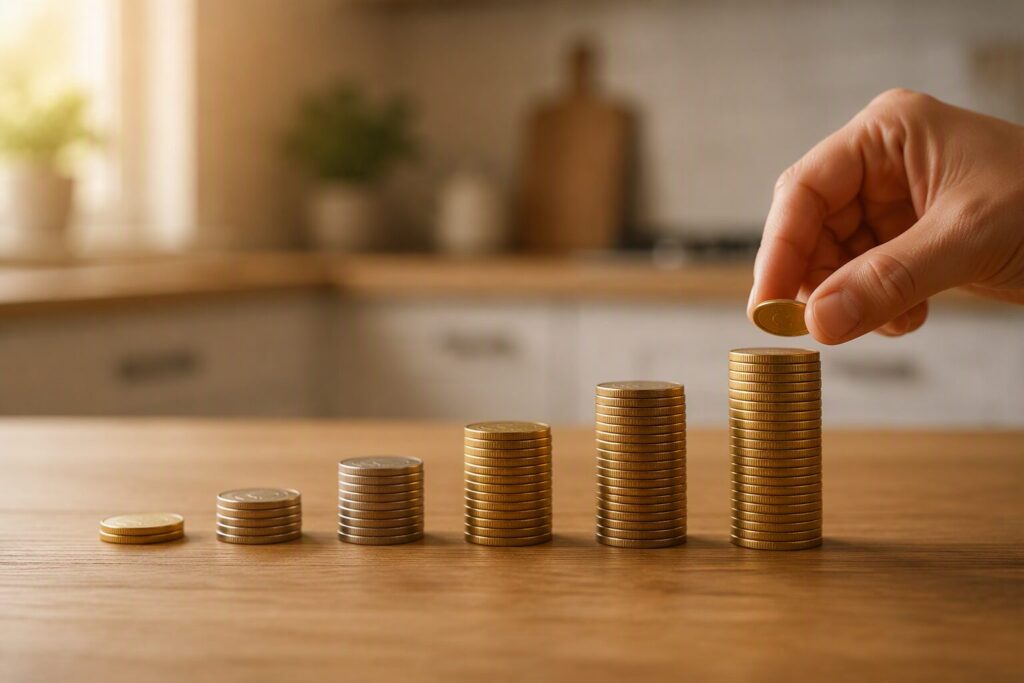
If you had first heard about Bitcoin as many did in the 2017 Bullrun and had started putting a modest $5 a day into Bitcoin at the highest point of 2017, today you would have $46,663 (as of 4/22/2022 2 am CTS), assuming you never sold at any high points. You would have only invested $7,935 to achieve this.
This is a nearly 500% gain.
Quick 2026 postscript on that math: seven months after I ran those numbers, Bitcoin bottomed near $16,000. The $5-a-day buyer never had to guess that bottom — the schedule caught it automatically. With Bitcoin in the low $60,000s as I write this update, those crash-era buys are the best performers of the whole run.
If you instead invested in Gold, your $7,935 would only be worth $9,198 (as of 4/22/2022 2 am CTS), and if you had chosen the DJI (Dow Jones Index), you would now have $9,906.
This is better than trying to time each market’s high and low points. I started to do this calculation but remembered some others had already done it Reddit poster u/jerschneid has made this nifty spreadsheet to break it down. Click here.
The post and the attached data show us that even if you hit the “perfect timing,” DCA investing still comes out ahead. This is because, at least, in this case, the compounding effect of your investment has a more significant impact than a perfect hindsight investment strategy.
You might feel like you know about DCA, but let me break things down and discuss some different ways you can approach this time-tested method.
Breaking Down DCA Strategies
The easiest thing you can do is find some automated method to get a DCA strategy working for you. I like hands-off things and use stuff like Coinbase, Acorns, and my bank to set up DCAs for me, which is a low effort on my part.
Another important concept to consider is it might be best if you have a set amount you will invest to break it up into smaller amounts and buy regularly.
You can set purchases or deposits up daily, weekly, or monthly. More frequently will do better, as we can see here (these tables are my April 2022 snapshot — I’ve kept them because the comparison between assets and frequencies is the lesson, not the exact dollar amounts):
DCA BTC – Dollar-Cost Averaging into Bitcoin
| Time | Freq. | Amt. | Result |
| 1 year | Daily | $5 ($1,825) | $2,144 |
| 1 year | Mon. | $250 ($3,000) | $3,647 |
| 5 year | Daily | $5 ($9,130) | $68,769 |
| 5 year | Mon. | $250 ($15,000) | $118,600 |
| 9 year | Daily | $5 ($16,435) | $1,476,455 |
| 9 year | Mon. | $250 ($27,000) | $2,479,161 |
DCA DJI – Dollar-Cost Averaging into the Dow Jones Index
| Time | Freq. | Amt. | Result |
| 1 year | Daily | $5 ($1,825) | $1,827 |
| 1 year | Mon. | $250 ($3,000) | $3,010 |
| 5 year | Daily | $5 ($9,130) | $11,796 |
| 5 year | Mon. | $250 ($15,000) | $19,497 |
| 9 year | Daily | $5 ($16,435) | $26,636 |
| 9 year | Mon. | $250 ($27,000) | $43,922 |
DCA Gold – Dollar-Cost Averaging into Gold
| Time | Freq. | Amt. | Result |
| 1 year | Daily | $5 ($1,825) | $1,809 |
| 1 year | Mon. | $250 ($3,000) | $2,970 |
| 5 year | Daily | $5 ($9,130) | $10,870 |
| 5 year | Mon. | $250 ($15,000) | $17,947 |
| 9 year | Daily | $5 ($16,435) | $21,360 |
| 9 year | Mon. | $250 ($27,000) | $35,130 |
How To Setup DCA on WeBull
I made a video about how to DCA on WeBull. I have another article I’m working on about buying Crypto on different platforms, and WeBull will be the first one I post about. So check out this video and how you can start using a Dollar-Cost Averaging strategy to grow your account and make investments. (Update, July 2026: WeBull pulled crypto out of the main app in 2023 and moved it to a separate Webull Pay app, then brought trading back in August 2025 after a two-year gap. The deposit-automation steps in the video still work the same way.)
How To Setup DCA CashApp
Cash App keeps this one simple: open the Bitcoin tab, choose a recurring purchase (they call it auto invest), and pick daily, weekly, or every other week. You can go as small as a dollar. It only does Bitcoin, which for a set-and-forget plan is honestly a feature, not a limitation.
How To Setup DCA Coinbase
Coinbase has recurring buys built in: pick an asset, tap the one-time purchase dropdown, and switch it to daily, weekly, twice a month, or monthly. One thing to watch — Coinbase charges a fee on each scheduled purchase, so a $35 weekly buy loses less to fees than $5 every day. Run your own numbers before you pick a frequency.